Best File Type for Scanning Documents - A Complete Guide
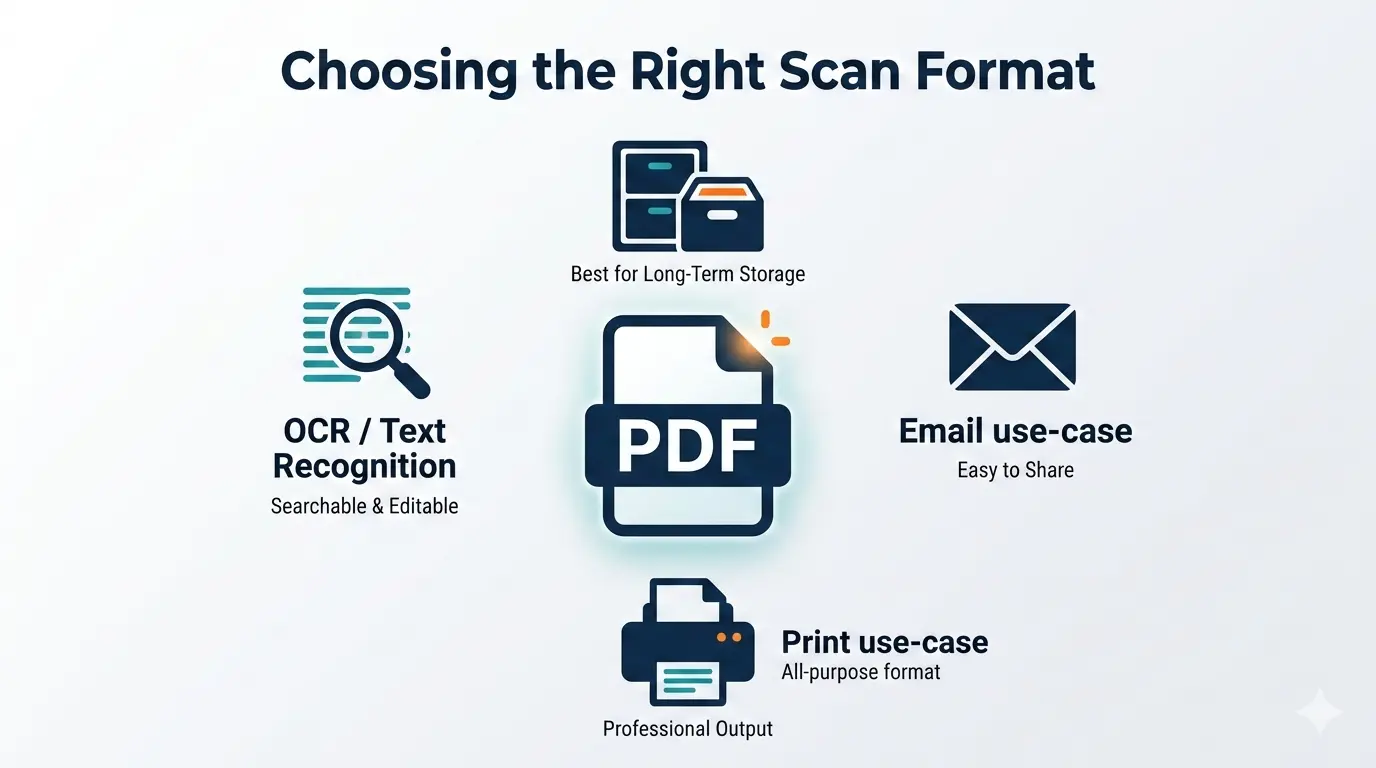
PDF is the best all-around file type for scanning documents. It handles multi-page files, looks professional, and works everywhere. But the best choice depends on what you plan to do with the scanned document—archive it, email it, print it, or run text recognition on it.
This guide explains the best file type for scanning documents based on your specific needs. You will learn when to choose PDF, TIFF, JPEG, or PNG, and how to get the right balance of quality and file size.
This guide explains the best file type for scanning documents based on your specific needs. You will learn when to choose PDF, TIFF, JPEG, or PNG, and how to get the right balance of quality and file size.
Scanning documents seems simple. You put the paper in, press a button, and get a digital file. But that file format matters more than you might think. The wrong format can give you huge files that are hard to email, blurry text that is hard to read, or compatibility issues when sharing.
Let us break down the options so you never have to wonder again.
Let us break down the options so you never have to wonder again.
What file type for scanning documents?
The most common file types for scanning documents are:
- PDF (Portable Document Format): The universal standard for documents. Preserves layout, supports multiple pages, and can contain both text and images.
- TIFF (Tagged Image File Format): Lossless format preferred for archiving and professional use. Supports multiple pages.
- JPEG (Joint Photographic Experts Group): Compressed image format. Small files but loses some quality. Best for single pages or photos.
- PNG (Portable Network Graphics): Lossless image format. Excellent for text and sharp lines but larger than JPEG.
For most document scanning, PDF is the best choice. It combines the benefits of other formats while being universally compatible.
What is the best file format for scanning?
The best file format depends on your goal. Here is a quick guide:
Is PNG or JPG better for scanning documents?
For documents with text, PNG is better than JPG. Here is why:
- Text clarity 📌 PNG uses lossless compression, so text stays sharp and crisp. JPG can introduce blurring and artifacts around letters, making small text harder to read.
- Sharp edges 📌 Lines, borders, and graphics stay clean with PNG. JPG softens edges.
- Solid colors 📌 Areas of solid color remain uniform with PNG. JPG can create visible noise.
However, PNG files are larger than JPG. A scanned letter as PNG might be 2-3 MB, while the same scan as JPG could be 300-500 KB. If file size is critical and the text is large enough, JPG can work.
Best practice: Use PNG for documents where text clarity is important. Use JPG only for quick, single-page scans where file size matters more than perfect quality.
Best practice: Use PNG for documents where text clarity is important. Use JPG only for quick, single-page scans where file size matters more than perfect quality.
Is TIFF or JPEG better for scanning documents?
TIFF is better than JPEG for document scanning when quality matters most:
- TIFF is lossless: It preserves every pixel exactly. Great for archiving and documents you may need to edit later.
- TIFF supports multiple pages: You can store a whole document in one TIFF file.
- TIFF has higher color depth: 16-bit support for professional use.
But TIFF files are huge. A 10-page document as TIFF could be 50-100 MB. The same document as high-quality JPEG might be 5-10 MB.
JPEG wins for file size and compatibility. It creates smaller files that are easier to email and share. But you lose quality, especially around text.
For most document scanning, PDF is better than both. It combines the quality control of TIFF with the smaller size of JPEG, plus multi-page support and universal compatibility.
JPEG wins for file size and compatibility. It creates smaller files that are easier to email and share. But you lose quality, especially around text.
For most document scanning, PDF is better than both. It combines the quality control of TIFF with the smaller size of JPEG, plus multi-page support and universal compatibility.
PDF: The all-around champion
PDF is the most versatile format for document scanning:
- Multi-page support: One file holds an entire document, from a 2-page letter to a 500-page book.
- Compression options: You can choose between small files (for email) and high quality (for printing).
- Universal compatibility: Every computer, phone, and tablet opens PDFs. No special software needed.
- Professional appearance: PDF looks like a real document, not a photo of a document.
- OCR ready: PDF works seamlessly with text recognition software to make your scans searchable.
- Security features: You can password-protect PDFs, which you cannot do with images.
For a detailed comparison, read our guide on should I scan documents as JPEG or PDF.
TIFF: The archival standard
TIFF is the preferred format for professional archiving and preservation:
- Lossless quality: Every pixel is preserved exactly. No quality loss, ever.
- High bit depth: 16-bit support for professional scanning.
- Metadata support: Store scanner settings, dates, and descriptions inside the file.
- Multi-page support: Keep entire documents in one file.
- Non-proprietary: TIFF is an open format that will be readable decades from now.
The downside? TIFF files are enormous. A single page can be 25-50 MB. For most everyday use, this is overkill.
JPEG: Quick and small
JPEG works well for:
- Single-page documents
- Quick scans where file size matters more than perfect quality
- Documents with photos or images (where JPEG excels)
- Sharing via text or social media
But remember: JPEG is lossy. Text can become blurry, and artifacts may appear around sharp edges. For documents with fine print, choose something else.
PNG: Perfect for text
PNG is ideal for:
- Documents with small text that must remain sharp
- Forms, contracts, and legal documents where clarity is critical
- Screenshots of documents
- Any document where you want lossless quality but don't need multi-page support
PNG files are larger than JPEG but smaller than TIFF. They offer the best balance of quality and size for text-heavy documents.
Quick reference: Which format for which document
Understanding DPI for document scanning
DPI (dots per inch) determines the resolution of your scan:
- 150 DPI: Good for drafts and email. Text is readable but not crisp. File size is small.
- 200 DPI: Acceptable for most documents. A good balance for email.
- 300 DPI: The standard for most document scanning. Good quality for printing and OCR. Balanced file size.
- 400-600 DPI: High quality for small text, fine print, or archival purposes. Files are large.
- 600+ DPI: Only needed for extremely small text or professional reproduction.
Recommendation: For regular document scanning, use 300 DPI. It gives you excellent quality without wasting storage space.
Color vs. Black & White vs. Grayscale
Your choice of color mode affects file size significantly:
- Black & White (1-bit): Smallest file size. Best for text-only documents with no images. Great for contracts and forms.
- Grayscale (8-bit): Medium file size. Good for documents with black-and-white photos or illustrations.
- Color (24-bit): Largest file size. Use only when color is important, such as for magazines, brochures, or documents with color coding.
For most business documents, black and white or grayscale is sufficient and saves significant space.
Best format for scanning documents for email
For email, PDF is the best choice:
- One file for the whole document (no multiple attachments)
- Compression options keep file sizes under email limits
- Professional appearance
- Opens on any device
Settings for email: Scan at 150-200 DPI in black and white or grayscale. Use PDF compression to keep files under 5 MB. For more detailed advice, read our guide on the best format to scan documents for email.
Best format for archiving documents
For long-term archiving, choose TIFF or PDF/A:
- TIFF: Lossless, widely supported, stores metadata. The archival gold standard.
- PDF/A: A special version of PDF designed for preservation. Embeds all fonts, prohibits encryption, ensures the file looks the same in 50 years.
Scan at 300 DPI in grayscale or color as needed. Store master copies in these formats, and create smaller versions for everyday use.
Best format for OCR (text recognition)
For OCR, use PDF or TIFF at 300 DPI in black and white or grayscale:
- 300 DPI gives the best balance of accuracy and file size
- Black and white or grayscale works better than color for text recognition
- Lossless formats (TIFF, PDF without compression) preserve fine details
- Avoid JPEG – compression artifacts can confuse OCR software
Best format for printing scanned documents
For printing, use PDF or TIFF at 300 DPI:
- 300 DPI gives good print quality for most documents
- PDF preserves layout and page size perfectly
- TIFF gives you lossless quality for professional printing
- JPEG can work for photos but may show artifacts on text
The professional workflow: Scan once to TIFF or PDF/A for your archive. Create PDF copies for sharing and JPEG previews for quick viewing. This gives you perfect preservation and practical convenience.
Common scanning mistakes to avoid
- Using JPEG for multi-page documents 📌 You end up with dozens of separate files. Use PDF instead.
- Scanning at too low resolution 📌 150 DPI might look fine on screen but becomes pixelated when printed. Stick to 300 DPI.
- Using color when not needed 📌 Black and white or grayscale saves significant space.
- Not checking the scan 📌 Always preview before saving. Look for crooked pages, shadows, or smudges.
- Forgetting OCR 📌 If you might need to search the text later, run OCR and save as searchable PDF.
The verdict: Best file type for scanning documents
For most purposes, PDF is the best file type for scanning documents. It handles multi-page files, compresses well, looks professional, and works everywhere.
Use TIFF for archiving when you need lossless quality and long-term preservation.
Use JPEG for quick, single-page scans where file size matters more than perfect quality.
Use PNG for text-heavy documents when you need perfect clarity and file size is not a concern.
Remember: Your choice depends on your goal. For more detailed guidance, read our comprehensive guide on which document scanning format is best and for photos specifically, see best file type for scanning photos for high quality.
Use TIFF for archiving when you need lossless quality and long-term preservation.
Use JPEG for quick, single-page scans where file size matters more than perfect quality.
Use PNG for text-heavy documents when you need perfect clarity and file size is not a concern.
Remember: Your choice depends on your goal. For more detailed guidance, read our comprehensive guide on which document scanning format is best and for photos specifically, see best file type for scanning photos for high quality.
Summary: PDF is the most versatile format for document scanning, ideal for multi-page files, email, and general use. TIFF is best for archiving with lossless quality. JPEG works for quick single-page scans. PNG excels for text clarity. Choose 300 DPI for most scans, and adjust color mode based on your document. Keep masters in lossless formats, and convert copies as needed.
Professional Image Conversion Without the Complexity
Image Converter 24 is built for professionals who need speed, reliability, and format flexibility. Convert TIFF, JPG, PNG, WebP and other formats instantly — directly from your browser — while maintaining high quality and full control over your workflow.
Start Converting Images