JPEG XL vs HEIF | Which Image Format Is Better?
JPEG XL is technically superior in compression, features, and royalty-free licensing, but HEIF has better current adoption thanks to Apple. JPEG XL is the better long-term choice for an open, universal format. HEIF is the practical choice today if you work primarily in the Apple ecosystem.
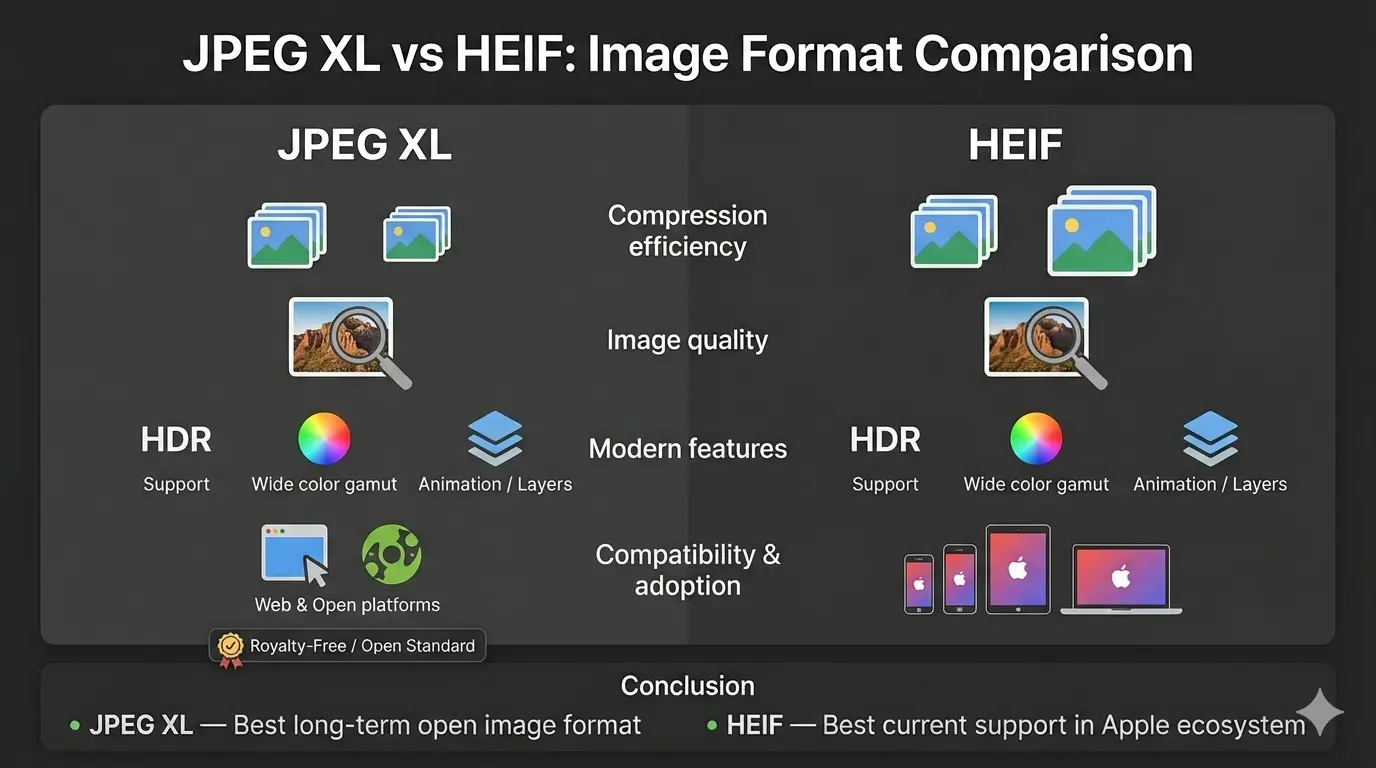
This guide compares JPEG XL vs HEIF across image quality, file size, modern features, and real-world compatibility. You will learn which format is better for your specific needs.
The world of image formats is changing fast. For decades, JPEG was king. Now we have two modern contenders: JPEG XL, designed by the same JPEG committee as a true successor, and HEIF, the format Apple chose for iPhones.
Let us break down the differences honestly.
Let us break down the differences honestly.
What is JPEG XL?
JPEG XL is a next-generation image format finalized in 2021. It was developed by the Joint Photographic Experts Group—the same committee that created the original JPEG.
Key features of JPEG XL:
Key features of JPEG XL:
- 30-50% better compression than original JPEG
- Lossy and lossless modes in one format
- HDR and wide color gamut support (Rec.2020, P3)
- Full alpha channel transparency
- Animation support
- Lossless JPEG recompression (unique feature)
- Fast encoding and decoding
- Royalty-free, open standard
- Progressive decoding
For a complete overview, read our guide on JPEG advantages and disadvantages.
What format is HEIF?
HEIF stands for High Efficiency Image File Format. It is a container format for storing images and image sequences.
Key features of HEIF:
Key features of HEIF:
- Can store multiple images in one file (bursts, Live Photos)
- Typically uses HEVC (H.265) compression for excellent efficiency
- About 50% smaller files than JPEG at same quality
- Supports 16-bit color, HDR, and transparency
- Adopted by Apple as the default format on iPhones (as .heic)
- Also used by some Android devices
HEIF is a container, not a compression method. It can use different codecs, but HEVC is the most common. For more on this relationship, read HEIF vs HEVC.
Is HEIF higher quality than JPEG?
Yes, HEIF typically offers higher quality than JPEG at the same file size. At comparable quality levels, HEIF files are about half the size of JPEG.
HEIF also supports features JPEG cannot match: 16-bit color, HDR, transparency, and multiple images per file.
For everyday photos, the difference is noticeable—especially on modern HDR displays.
HEIF also supports features JPEG cannot match: 16-bit color, HDR, transparency, and multiple images per file.
For everyday photos, the difference is noticeable—especially on modern HDR displays.
Is JPEG XL competing with HEIC?
Yes, absolutely. HEIC is Apple's implementation of HEIF (using HEVC compression). JPEG XL is designed to be a universal replacement for JPEG that competes directly with HEIC.
Both formats offer:
Both formats offer:
- Better compression than JPEG
- HDR and wide color gamut support
- Transparency
- Animation capabilities
The competition is about which becomes the next universal standard.
Is JPEG lower quality than HEIF?
At the same file size, yes, HEIF generally produces better quality than JPEG. At the same quality level, HEIF files are much smaller.
Original JPEG is a 1992 technology. HEIF (with HEVC) uses modern compression algorithms that preserve more detail while using less data.
However, a high-quality JPEG (95-100%) still looks excellent for most purposes. The difference is most noticeable in challenging areas like skies, gradients, and fine details.
Original JPEG is a 1992 technology. HEIF (with HEVC) uses modern compression algorithms that preserve more detail while using less data.
However, a high-quality JPEG (95-100%) still looks excellent for most purposes. The difference is most noticeable in challenging areas like skies, gradients, and fine details.
Is JPEG XL better?
Technically, yes, JPEG XL has several advantages over HEIF:
- Better compression 📌 Independent tests show JPEG XL often matches or slightly beats HEIF/HEVC compression efficiency.
- Royalty-free 📌 JPEG XL is completely royalty-free. HEIF/HEVC involves patent licensing, which has caused issues in some contexts.
- Lossless JPEG recompression 📌 JPEG XL can losslessly recompress existing JPG files to 80% size. HEIF cannot.
- Faster encoding 📌 JPEG XL is generally faster to encode than HEIF/HEVC.
- Progressive decoding 📌 JPEG XL has excellent progressive decoding built in.
However, HEIF has better current adoption thanks to Apple.
Will HEIF eventually replace JPEG?
HEIF has made significant progress, primarily through Apple's adoption. Every iPhone user now has HEIC files. But "replace JPEG" is a tall order.
JPEG has been the universal standard for over 30 years. Replacing it requires universal support across all platforms, browsers, and software. HEIF is strong in the Apple ecosystem but less common elsewhere.
JPEG XL was designed specifically to replace JPEG, with better compatibility and an open standard. The battle is not over.
JPEG has been the universal standard for over 30 years. Replacing it requires universal support across all platforms, browsers, and software. HEIF is strong in the Apple ecosystem but less common elsewhere.
JPEG XL was designed specifically to replace JPEG, with better compatibility and an open standard. The battle is not over.
What are the disadvantages of HEIF?
HEIF has several drawbacks compared to JPEG XL:
- Patent issues: HEVC (the compression used in HEIF) involves complex patent licensing. This has caused problems for some platforms and may discourage adoption.
- Slower encoding: HEVC encoding is computationally expensive, making it slower than JPEG XL.
- Limited browser support: HEIC files do not work in most web browsers. Safari supports them, but Chrome, Firefox, and Edge do not.
- Apple-centric: HEIF adoption is strongest on Apple devices. Windows and Android support is improving but inconsistent.
- No lossless JPEG recompression: HEIF cannot help you shrink your existing JPG library.
For help with conversion, see how to convert an image to JPEG format.
JPEG XL vs HEIF | Head-to-head comparison
File size comparison
Let us compare a typical 10-megapixel photo in different formats:
Both formats offer dramatic improvements over JPEG. JPEG XL often has a slight edge in compression efficiency.
When to use JPEG XL
Choose JPEG XL when:
- You want a royalty-free, open standard for the future
- You need lossless JPEG recompression for archiving
- You care about fast encoding and decoding
- You want the best possible compression efficiency
- You are preparing for the future and can provide fallbacks
- You work with HDR content
When to use HEIF
Choose HEIF when:
- You are in the Apple ecosystem (iPhone, iPad, Mac)
- You want to save space on your Apple devices
- You need Live Photos or burst mode support
- You are sharing primarily within Apple's ecosystem
- You are comfortable with potential patent licensing issues
- You need a format that is already widely deployed on millions of devices
Simple rule: Use HEIF if you are all-in on Apple. Use JPEG XL if you care about an open future and want the technical best.
Compatibility: The practical reality
HEIF/HEIC support:
- Apple devices: Full support (iOS, macOS)
- Windows: Requires HEVC extensions (some free, some paid)
- Android: Support varies by version and device
- Web browsers: Safari only
- Websites: Most convert to JPEG on upload
JPEG XL support:
- Safari: Full support
- Firefox: Available behind a flag
- Chrome: Experimental support removed in 2023
- Edge: Follows Chrome, not supported
- Software: Growing support in tools like ImageMagick, GIMP
Neither format has universal support yet.
The patent question
One of the biggest advantages of JPEG XL is its royalty-free licensing. The JPEG committee worked to ensure all essential patents have expired or are available under royalty-free terms.
HEIF uses HEVC compression, which involves a complex patent pool. This has caused:
HEIF uses HEVC compression, which involves a complex patent pool. This has caused:
- Licensing fees for some commercial uses
- Confusion about what is and isn't allowed
- Some platforms avoiding HEVC support due to patent risks
- Different implementations across operating systems
For open-source and web use, this is a significant advantage for JPEG XL.
The future of both formats
HEIF has momentum thanks to Apple. Every new iPhone creates HEIC files. But Apple also controls its ecosystem tightly—they can switch formats if they choose.
JPEG XL has technical superiority and an open standard. It is designed to be the true JPEG successor. But it lacks the marketing power of Apple.
The winner is not yet clear. Both may coexist for different purposes.
JPEG XL has technical superiority and an open standard. It is designed to be the true JPEG successor. But it lacks the marketing power of Apple.
The winner is not yet clear. Both may coexist for different purposes.
The verdict: JPEG XL vs HEIF
JPEG XL is the technical winner. It offers slightly better compression, faster encoding, royalty-free licensing, and unique features like lossless JPEG recompression. For an open, universal future format, JPEG XL is the better choice.
HEIF is the practical winner today. It is already on billions of devices thanks to Apple. If you work in the Apple ecosystem, HEIF is convenient and effective.
The smart choice depends on your needs:
HEIF is the practical winner today. It is already on billions of devices thanks to Apple. If you work in the Apple ecosystem, HEIF is convenient and effective.
The smart choice depends on your needs:
Final thought: Both formats are excellent and far superior to JPEG. If you are starting fresh, consider JPEG XL for its openness and technical merits. If you are an iPhone user, HEIF is already working for you. The future may bring more convergence.
Summary: JPEG XL offers slightly better compression, faster encoding, royalty-free licensing, and unique features like lossless JPEG recompression. HEIF benefits from Apple's adoption and is already on billions of devices. Both support modern features like HDR and transparency. Choose JPEG XL for an open future; choose HEIF for Apple ecosystem convenience.