AVIF vs JPEG XL - Choosing the Right Modern Image Format
The era of JPEG and PNG dominance is fading, making way for a new standard in web performance. The real debate now centers on AVIF vs JPEG XL: two powerful formats vying to redefine the balance between ultra-light file sizes and high-fidelity quality. While both promise a faster, sharper web, they excel in very different arenas. Here is everything you need to know about this modern image showdown.
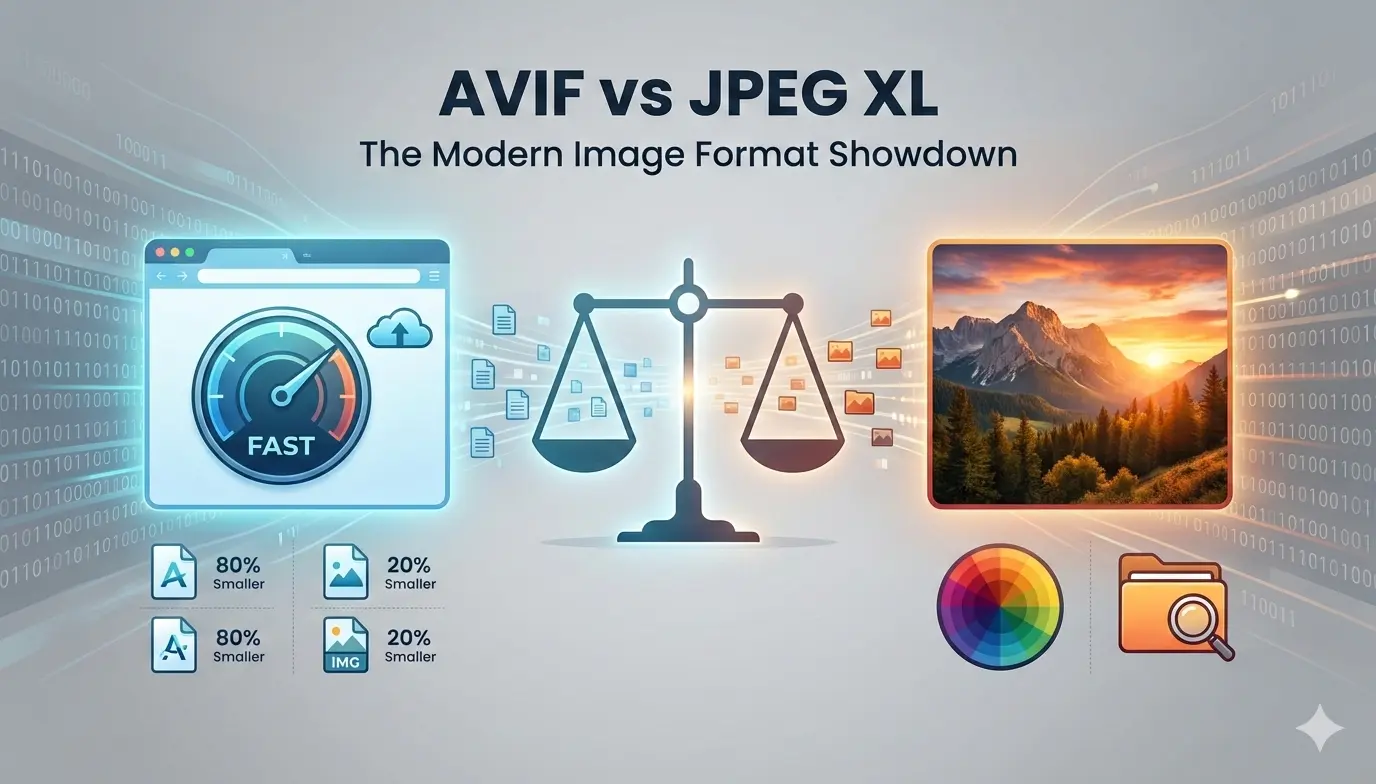
This guide will break down AVIF vs JPEG XL in simple terms. We’ll look at what each format is, compare their performance, and show you the best places to use them. By the end, you’ll know exactly which format to choose for your website, projects, or archives.
What is AVIF? The Modern Web Powerhouse
AVIF (AV1 Image File Format) is a cutting-edge image format based on the AV1 video codec. It was created by the Alliance for Open Media (AOMedia), a group that includes tech giants like Google, Mozilla, and Netflix. Its main goal is to deliver high-quality images at much smaller file sizes than older formats like JPEG or PNG.
AVIF supports advanced features that are perfect for today’s web:
- Superior Compression: It can shrink image files by 50% or more compared to JPEG while keeping the same visual quality.
- High Dynamic Range (HDR): It displays a wider range of colors and brightness, making images more vibrant and lifelike.
- Transparency (Alpha Channel): Like PNG, it supports transparent backgrounds, but with a much smaller file size.
- Animation: It can store animated images, similar to GIF or WebP, but with far better quality and compression.
- Wide Color Gamut: It supports modern color spaces like Rec. 2020 and P3, which are used in HDR displays.
In short, AVIF is built for speed and efficiency. It’s designed to make websites load faster by reducing image weight without sacrificing visual appeal. This is a huge advantage for user experience and SEO.
What is JPEG XL? The Versatile Quality Leader
JPEG XL is another modern image format, created as a true successor to the original JPEG. It was developed by the Joint Photographic Experts Group (the same team behind JPEG) with a focus on versatility, high fidelity, and backward compatibility.
While also offering excellent compression, JPEG XL aims to be a universal format suitable for many different uses, not just the web. Its standout features include:
- Lossless and Lossy Compression: You can choose to compress images without any quality loss (perfect for archiving) or with smart lossy compression for smaller files.
- Progressive Decoding: Images load in stages, quickly showing a rough version that gets clearer, which is great for slower connections.
- HDR and Wide Gamut Support: Like AVIF, it fully supports high dynamic range and modern color profiles.
- Backward Compatibility: A unique feature is its ability to recompress old JPEG files into JPEG XL with zero generational loss, saving space while preserving the original.
- Advanced Features: It supports layers, animation, and flexible metadata, making it useful for professional photography and editing.
JPEG XL is about flexibility and maximum quality. It’s an excellent choice for photographers, designers, and anyone who needs a reliable, high-quality format for storage and professional work. For a deeper dive into how it compares to its predecessor, you can read about JPEG XL vs JPEG XR.
AVIF vs JPEG XL: Head-to-Head Comparison
To truly understand which format is better for your needs, let’s compare them across the most important factors. The table below gives you a clear, at-a-glance overview.
| Feature | AVIF | JPEG XL |
|---|---|---|
| Primary Strength | Extreme compression for the web | Versatility & high-fidelity storage |
| Best For | Website images, product photos, banners | Photo archives, professional editing, HDR content |
| Compression Efficiency | Excellent (often better at low file sizes) | Excellent (often better at high-quality, lossless modes) |
| HDR Support | Yes (Rec. 2100, PQ/HLG) | Yes (Rec. 2100, PQ/HLG) |
| Transparency | Yes (with great compression) | Yes |
| Animation | Yes | Yes |
| Browser Support | Chrome, Firefox, Edge, Opera (Safari partial) | Limited (Firefox flag, Chrome flag removed) |
| Encoding/Decoding Speed | Slower to encode, fast to decode | Moderate to encode and decode |
| Royalty-Free | Yes | Yes |
Important Note: Browser support is a critical practical difference. AVIF is widely supported in modern browsers today, making it ready for production websites. JPEG XL, despite its technical strengths, lacks this native browser support, which limits its immediate use for web content.
Image Quality & File Size | The Core Trade-Off
Both formats deliver stunning quality, but they approach compression differently.
- AVIF is a champion at aggressive compression. For the same perceived visual quality as a JPEG, an AVIF file can be up to 50% smaller. This is its killer feature for the web.
- JPEG XL is incredibly efficient across the entire quality spectrum. It excels at lossless compression and often produces better-looking images than AVIF at medium to high bitrates, with fewer compression artifacts.
Verdict: Need the smallest possible file? Use AVIF. Prioritizing the absolute best visual fidelity, especially for archiving or professional use? JPEG XL has the edge.
Browser Support & Practical Usage
This is where the rubber meets the road. You can have the best format technically, but if users' browsers can't display it, it's not useful.
- AVIF Support: Strong and growing. You can confidently use AVIF on most websites today, providing a fallback (like WebP or JPEG) for older browsers.
- JPEG XL Support: Very limited. As of now, it's not a viable choice for general web use. Its strength lies in desktop applications, archiving, and professional workflows.
Best Use Cases | When to Choose Which Format
Now that we've compared them, let's get practical. Here’s a clear guide on where each format shines.
✅ Choose AVIF For:
- Modern Website Assets: Hero images, product photos, blog graphics. The smaller size directly improves page load speed and Core Web Vitals scores.
- E-commerce Platforms: Where you have thousands of product images, AVIF's compression can save huge amounts of bandwidth and storage.
- Content Delivery Networks (CDNs): Many CDNs now automatically convert images to AVIF for supported browsers, making implementation easy.
- Apps and PWAs: To reduce the overall download size of the application and improve performance.
"Adopting AVIF for our main website imagery resulted in a 40% reduction in image payload. The visual quality remained impeccable, and our page speed insights scores saw a significant boost." – A common developer experience.
✅ Choose JPEG XL For:
- Long-Term Image Archiving: Its lossless compression and ability to recompress old JPEGs make it ideal for preserving photo libraries without wasting space.
- Professional Photography & Editing: As an intermediate editing format that supports HDR and wide color gamuts without generational loss.
- Desktop Applications & Printing: Where browser support isn't a concern and the highest possible image fidelity is required.
- Future-Proofing Content: Storing master copies of images in JPEG XL ensures they are in a modern, capable format ready for when support becomes universal.
Practical Tips for Conversion and Implementation
Knowing is half the battle. Here’s how to put this knowledge into action.
- When to convert from JPEG/PNG to AVIF 📌 Convert your website's static images (JPEGs and PNGs) to AVIF. Start with large images that impact loading speed the most. Use tools like Squoosh, Sharp, or an online image converter. Always implement with a fallback using the HTML `
` element. - When is JPEG XL better for quality? 📌 Use JPEG XL when you are creating a master copy of a photo from your camera, scanning important documents, or building a digital archive. Its lossless mode guarantees the file you save is a perfect copy of the original, but in a more efficient package.
- Workflow Integration 📌 Consider a dual-format workflow: Use JPEG XL as your high-quality "digital negative" for storage and editing. Then, export to AVIF as the optimized version specifically for web publication.
- Testing is Key 📌 Before fully switching, test AVIF conversion on a variety of your images. Check for any unexpected artifacts, especially in images with fine details, text, or gradients. Compare the file size savings against the visual result.
The Future of AVIF and JPEG XL
The landscape of image formats is still settling. AVIF has gained tremendous momentum thanks to strong industry backing and immediate browser support. It is well on its way to becoming the default next-gen format for the web, alongside WebP.
JPEG XL faces a more uncertain path due to the current lack of browser support. However, its superior technical merits for quality and archival keep it highly relevant for specific professional and storage use cases. The community continues to advocate for its adoption.
The good news? You don't have to pick just one forever. Understanding their strengths allows you to use the right tool for the right job today, while keeping an eye on the developments of tomorrow.
Final Recommendation | Which One Should You Use Now?
Let’s make this simple:
- For Websites & Web Apps: Implement AVIF today. The performance benefits are real, user experience improves, and support is wide enough. It's the most impactful change you can make for web image optimization.
- For Archiving & Professional Work: Adopt JPEG XL for your master files and editing pipeline. Its quality preservation and versatility are unmatched, making it a responsible choice for long-term value.
Both AVIF and JPEG XL represent significant leaps forward from older formats. By strategically using both, you can achieve optimal performance for your users and pristine quality for your assets.
Conclusion: The debate between AVIF vs JPEG XL isn't about finding a single winner. It's about understanding two powerful tools designed for different, yet sometimes overlapping, purposes. AVIF is your go-to for a faster, more efficient web. JPEG XL is your guardian for maximum quality and flexible storage. By embracing the strengths of each, you can ensure your images look their best, load quickly, and are preserved for the future. Start experimenting with conversion and see the benefits for yourself.