MIME Type JPG | Do you know what type of content is right?
image/jpeg. Web servers and browsers use this specific identifier to communicate the exact nature of an image file. If you want to achieve success in web development, you must understand how to configure these content types correctly. Choosing the right data type ensures your images load perfectly, improves website security, and enhances overall user experience.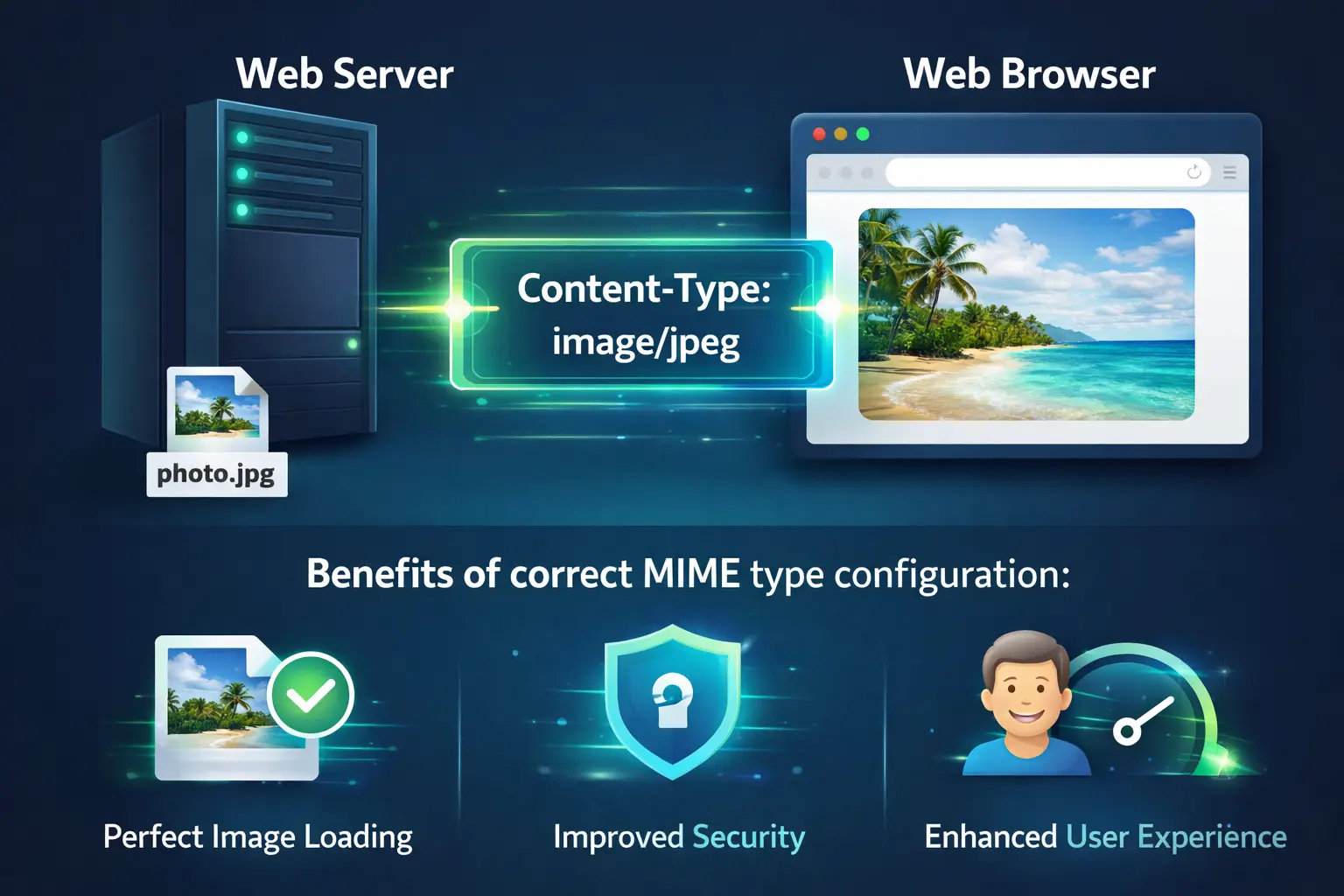 |
| Configuring the correct mime type jpg ensures optimal web performance. |
What is a MIME type file?
- Learn the basic structure consisting of a type and a subtype (e.g., text/html or image/webp) to categorize content accurately.
- Configure your web server software to automatically attach the correct headers to outgoing files.
- Test your website responses using developer tools to ensure the browser receives the proper data labels.
- Communicate with back-end developers to establish strict upload validation rules for user-generated content.
- Review and update your server configurations regularly to support newer media formats smoothly.
- Invest in secure coding practices to prevent malicious files from masking their true nature.
How to open a MIME type file?
- Identify the format 📌 Before opening the file, the system reads the data label to understand if it is a video, text, or image. This step happens instantly in the background.
- Use a web browser 📌 Browsers like Chrome, Firefox, or Safari excel at reading these labels. They process the standard mime type jpg flawlessly and render the picture on your screen.
- Rely on default software 📌 Your computer OS uses default photo viewers or media players to open downloaded files based on their internal signatures.
- Bypass broken extensions 📌 If a file has the wrong extension but the correct server label, a smart browser will still open it correctly.
- Check the properties 📌 You can inspect the network tab in your browser developer tools to see the exact label the server assigned to the file.
- Fix association errors 📌 Sometimes, your computer loses the link between a file kind and a software program. You just need to right-click and choose "Open With" to fix this.
- Handle raw data 📌 If a browser encounters an unknown label like application/octet-stream, it will prompt you to download the file instead of opening it.
- Stay patient and careful 📌 Opening unknown files carries security risks. Always ensure you trust the source before double-clicking a downloaded document.
What file type is a JPEG?
- High Compression Rates The algorithm shrinks large photos into tiny file sizes, which saves bandwidth and storage space.
- Lossy Nature Every time you save the picture, it loses a tiny bit of quality. You should avoid editing and resaving the same file repeatedly.
- Best for Photographs The format handles complex colors, gradients, and real-world lighting beautifully.
- No Transparency Unlike other formats, it does not support transparent backgrounds. It always fills empty spaces with a solid color, usually white.
- Universal Compatibility Every device, browser, and operating system supports it natively without requiring extra software.
- Adjustable Quality You can choose the exact balance between file size and visual clarity when you export the picture from an editor.
- Standardized Identification Servers identify this format using a strict rule. If you want to dive deeper into this specific rule, check out the jpeg mime type to see how servers handle it.
Is PNG a MIME type?
image/png. Servers use this label to tell browsers to expect an image with lossless compression and possible transparency.Many people confuse the file extension with the data label. While the extension is .png, the internet data label acts as the official passport for the file across the web. This guarantees that browsers treat the file correctly, preserving its crisp edges and transparent backgrounds. If a server sends a PNG but labels it as a mime type jpg, the browser might get confused and render the image incorrectly.
You can easily boost your site reliability by ensuring every file format pairs with its proper label. If you work with web graphics like logos or icons, you will use PNG frequently. To ensure you configure your server correctly for these graphics, you should understand the mime type for PNG and apply it properly.
The Difference Between image/jpeg and image/jpg
Understanding the exact phrasing of the mime type jpg format is critical for developers. When you build a website, you want everything to function perfectly. You might assume that because the file extension is .jpg, the data label should be image/jpg. This assumption leads to many subtle technical errors.
- The Official Standard 👈 The Internet Assigned Numbers Authority (IANA) defines
image/jpegas the only official label. This is the global standard for this kind of picture. - The Common Mistake 👈 Many developers mistakenly write
image/jpgin their code. While some modern browsers forgive this error, older systems and strict APIs will reject the file. - Upload Form Failures 👈 If you build a file upload form and only accept image/jpg, users uploading standard photos will face frustrating error messages.
- Server Misconfigurations 👈 A server configured to send the wrong label can cause images to download instead of displaying inline.
- API Integrations 👈 Third-party services, like payment gateways or identity verification APIs, strictly demand the official image/jpeg string.
- The Extension Disconnect 👈 Remember that the three-letter file extension (.jpg) exists mostly because old Windows systems limited extensions to three characters. The full format name remains JPEG.
Common Mistakes in Using Content-Type
- Relying on File Extensions Do not trust the file extension alone. A user can rename an executable virus to photo.jpg. If your server does not check the actual file contents, you risk a massive security breach.
- Using Generic Labels Setting the label to
application/octet-streamfor an image forces the browser to download the picture instead of displaying it. This ruins the visual flow of your page. - Ignoring Case Sensitivity While browsers often ignore case, best practices dictate writing the label in all lowercase letters. Writing IMAGE/JPEG might break strict validation scripts.
- Forgetting Form Validation When you create an HTML input form, you must use the accept attribute correctly. Writing
accept="image/jpg"limits users. You should writeaccept="image/jpeg"to follow the mime type jpg rules correctly. - Caching the Wrong Headers If a server accidentally sends the wrong header and the browser caches it, the user will continue seeing a broken image even after you fix the server. You must clear the cache.
- Mixing Up Formats Developers sometimes serve a WebP file but label it with the mime type jpg. Modern browsers might sniff the file and fix it, but you waste processing power and risk display bugs.
- Incomplete API Responses Mobile applications rely heavily on accurate headers. If your API sends a photo with an empty Content-Type, the mobile app might crash trying to parse the data.
- Security Vulnerabilities Incorrect labels allow MIME sniffing attacks. Hackers disguise malicious scripts as images. Always enforce strict server rules to prevent browsers from guessing the content.
How to Use It in HTML and HTTP Headers
Applying the correct mime type jpg label in your code requires attention to detail. Whether you write HTML elements or configure backend servers, you need to use the standard image/jpeg string. This practice improves rendering speed and SEO performance.
When you write HTML, you usually do not need to specify the type for standard image tags. The browser detects it automatically. However, when you use the <picture> element for responsive design, you must declare it. For example, you offer a WebP version first, then fallback to the standard photo format:
<source srcset="photo.webp" type="image/webp">
<img src="photo.jpg" type="image/jpeg" alt="Beautiful landscape">
</picture>
For server configurations, HTTP headers do the heavy lifting. When a browser requests a picture, the server replies with headers before sending the actual image data. The header looks like this: Content-Type: image/jpeg. If you use an Apache server, you manage this in the .htaccess file. Apache handles the mime type jpg mapping automatically, but you can force it if needed using the AddType directive.
In Nginx servers, the mapping lives in the mime.types file. You will see a line that maps both .jpg and .jpeg extensions to the single, official image/jpeg label. By maintaining these server files, you ensure the browser never has to guess what kind of file it receives.
Ultimately, your commitment to learning these technical configurations shows your dedication to web quality. It results in faster load times, better security, and a flawless experience for your visitors. Always use the official standard and avoid shortcuts.
Why You Might Need an Image Converter
- Format Correction.
- File Size Reduction.
- Extension Matching.
- Batch Processing.
- Quality Retention.
- Standardizing Uploads.
- Fixing Corrupt Headers.
image/jpeg standard instead of incorrect variations. By understanding how servers and browsers communicate, you can prevent broken layouts and security flaws. Ensure you always validate user uploads and configure your server headers accurately.Furthermore, adopting the correct mime type jpg practices directly impacts your website's search engine optimization. Search engines prefer fast, error-free sites with properly labeled media. By using these strategies and relying on high-quality conversion tools when necessary, you build a digital presence that performs flawlessly across all devices and platforms.
Efficient workflows start with the right tools. When handling multiple image formats, having a fast and reliable converter can make a noticeable difference in both productivity and output quality.
Image Converter 24 is designed to simplify this process — allowing you to convert TIFF, JPG, PNG, and WebP files directly from your browser with minimal effort.
Explore Image Converter 24